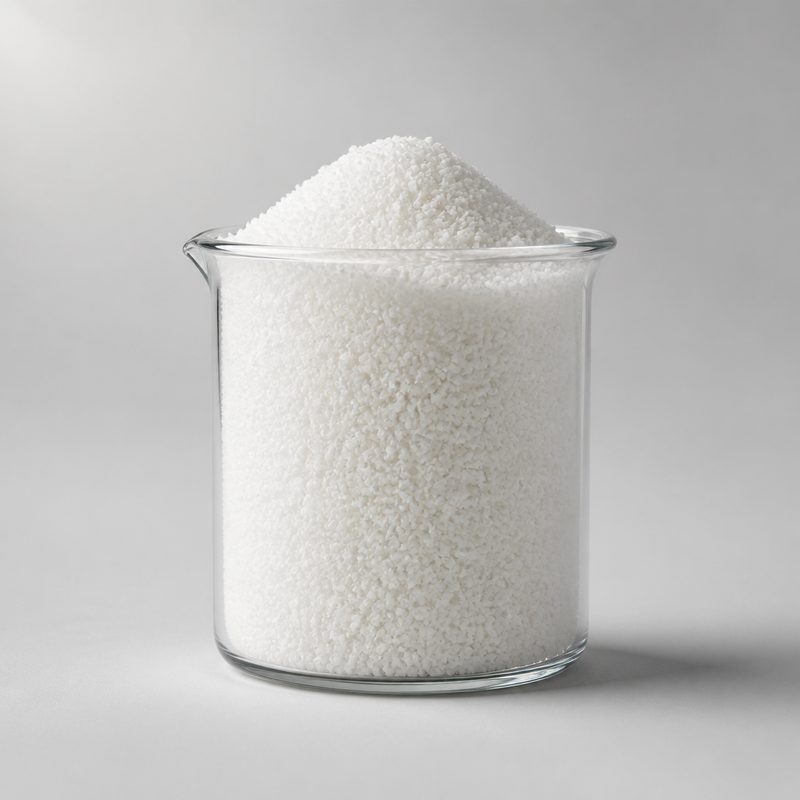
Sodium polyacrylate super absorbent polymer that absorbs hundreds of times its own weight in water and releases it slowly to the root zone.
Super absorbent polymer is a lightly cross-linked polyacrylate network. When water enters the dry granule the sodium ions on the polymer chain dissociate and the resulting osmotic pressure pulls water in, while the cross-links stop the network from dissolving. A single gram can hold several hundred grams of water, and because the water is held inside the network rather than in the pore spaces of the granule, it does not drain away under gravity. That is the property that separates it from any conventional soil amendment.
In the soil, the swollen granule acts as a small reservoir. Water taken up during irrigation or rainfall is released gradually as the surrounding soil dries and the osmotic balance shifts back towards the soil solution, which keeps the root zone moister for longer between waterings and improves seedling survival through a dry spell. Absorption falls in saline or very hard water because the dissolved ions reduce the osmotic driving force — that is inherent to the chemistry rather than a defect. For saline conditions a potassium-based grade and a higher application rate are the usual answer. The same material is used industrially as an absorbent in packaging, cable water-blocking tapes and concrete curing.
| Chemistry | Sodium polyacrylate, lightly cross-linked |
|---|---|
| Appearance | White to off-white granules |
| Water absorption (deionised water) | 300 – 500 times own weight |
| Absorption in 0.9% saline | 50 – 80 times own weight |
| Particle size | 0.2 – 2 mm, sized to order |
| Moisture content | ≤ 10% |
| Bulk density | 0.65 – 0.85 g/cm³ |
| pH (0.1% dispersion) | 5.5 – 7.0 |
| Free swell rate | Completes within 15 – 60 minutes depending on granule size |
| Packaging | 25 kg bags / 750 kg bulk bags |
| Shelf life | 24 months in unopened packaging, dry and sealed |
In soil application the granule has to end up in contact with the root zone, because dry granules on the surface absorb little and add nothing. Incorporate 15 – 60 kg per hectare into the topsoil before sowing or planting, or place a smaller quantity directly in the planting hole where the value of each plant justifies the higher unit cost. Mix the granule through the soil rather than leaving it in a layer, and pre-wet the planting hole after incorporation so the polymer has time to swell before the seedling's first critical days. Do not apply dry onto the surface, and do not leave the granule swelling in a bucket of water before incorporation; both practices waste most of the product.
Typical dosage. 15 – 60 kg per hectare incorporated into the root zone, or a few grams per planting hole. Higher rates are needed in saline or very sandy soils.
Why does absorption drop in saline or hard water? The swelling is driven by the difference in ionic concentration between the network and the surrounding water. Dissolved salts narrow that difference, so the polymer takes up less water and the gel is weaker. This is inherent to the chemistry, and the practical responses are a potassium-based grade and a higher application rate.
How much do I need per hectare? Typically 15 to 60 kg per hectare incorporated into the root zone, with the higher end of that range for sandy or saline soils. Placing a few grams in each planting hole costs more per hectare but concentrates the benefit where it is most valuable.
Can I just spread it on the surface? No. The granule must be in the soil and in contact with both moisture and roots to be useful. Left dry on the surface it absorbs little and is easily lost to wind or runoff.
How long does it last in the soil? The cross-linked network is not readily degraded by soil biology, so a single incorporation keeps working across several seasons, with effectiveness declining gradually as the gel structure is broken down by mechanical action and by repeated wetting and drying.
Is it safe for plants and soil? Sodium polyacrylate is widely used in agriculture and horticulture. Sodium-based grades can contribute sodium to the soil over time, which is why potassium-based grades are preferred where soil salinity is already a concern.
Does it work for industrial absorption as well? Yes. The same material absorbs aqueous liquids in packaging, spill control and cable water-blocking. Tell us the liquid and the containment requirement and we will confirm whether the standard grade is suitable.
Related