Nonionic polyacrylamide that keeps its bridging performance in acidic, high-salinity and variable-load water, plus soil stabilisation and drilling uses.
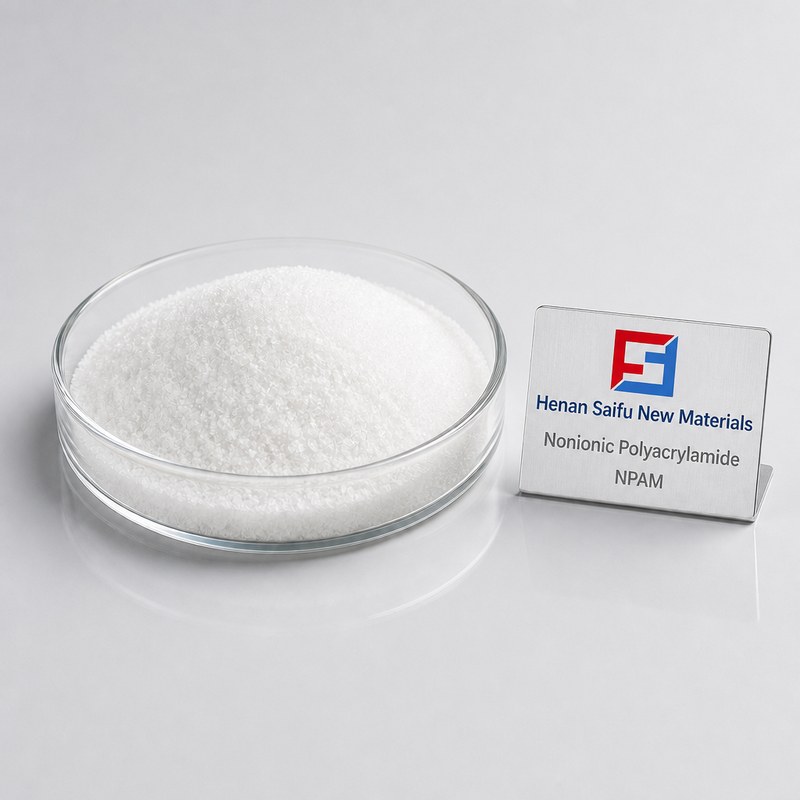
Nonionic polyacrylamide carries little or no ionic charge, so its flocculation comes almost entirely from the bridging mechanism. That makes it the tolerant member of the family: it keeps working in acidic media, in water with a high dissolved salt load, and in streams whose ionic character swings through the day, all of which are conditions where charged polymers lose efficiency or demand a much higher dose.
Because charge is not doing any of the work, molecular weight and chain length decide performance. The grade is chosen on the basis of the water analysis rather than a charge number, and the typical answer for a difficult stream is a high molecular weight nonionic polymer dosed after pH correction where that is economical. Outside water treatment, the same chemistry is used to bind soil surfaces against wind and water erosion and to raise the viscosity of drilling and tunnelling fluids.
| CAS No. | 9003-05-8 |
|---|---|
| Chemical family | Polyacrylamide homopolymer |
| Ionic charge | Nonionic (near-neutral) |
| Degree of hydrolysis | ≤ 5% |
| Molecular weight | 8 – 15 million |
| Appearance | White to off-white granules |
| Solid content | ≥ 88% |
| Bulk density | 0.60 – 0.80 g/cm³ |
| Particle size | < 2 mm, ≥ 90% passing |
| Dissolution time | 60 – 120 minutes at 0.1% solution |
| Water insolubles | ≤ 0.2% |
| Effective pH range in use | 3.0 – 9.0 |
| Packaging | 25 kg woven bags / 750 kg and 1000 kg bulk bags |
| Shelf life | 24 months in unopened packaging, cool and dry |
Nonionic grades are the slowest of the polyacrylamides to dissolve, so allow the full maturation time before the solution is dosed. Prepare a 0.1% – 0.3% stock solution in clean water with gentle agitation; the solution should be smooth and free of gel particles before it is diluted to working strength. In clarification service, dose downstream of any coagulant into a zone of moderate turbulence. For soil stabilisation, dilute to about 0.1% – 0.5% and spray the surface so that the polymer binds the top few millimetres of soil; a second pass after the first has dried gives a more durable crust.
Typical dosage. 1 – 20 g per m³ in water treatment, or 2 – 5 g/m² for soil stabilisation. Bench-test the stream before fixing the rate.
When should I choose NPAM rather than APAM? When the stream is strongly acidic, carries a high dissolved-salt load, or changes character frequently. In those conditions the anionic charge is screened out or wasted and the nonionic polymer holds its bridging performance at a lower dose.
How is NPAM used for soil stabilisation? Dilute to roughly 0.1% – 0.5% and spray it over the prepared surface, or mix it into the top layer of soil. The polymer binds the surface particles together, which suppresses dust and resists wind and rain erosion, and it improves water retention in the treated layer.
Why does it take longer to dissolve than other grades? Without ionic groups to help the chains separate, the granule wets out more slowly. Give it the full maturation time and gentle agitation rather than adding more energy, which only creates fish-eyes and waste.
Is NPAM suitable for drinking water treatment? Potable-water and food-contact grades exist and are supplied with the relevant documentation. Tell us the target application and the approval regime you work under and we will confirm the grade.
Can it be used in a circuit that also handles alkaline water? Yes. Nonionic polymer is effective from about pH 3 to pH 9, which makes it a practical choice where a single make-up system serves more than one stream.
What information do you need to recommend a grade? A water or slurry analysis including pH, suspended solids, hardness and conductivity, plus a note of the equipment and the target result. From that we will suggest a molecular weight and confirm it with a sample.