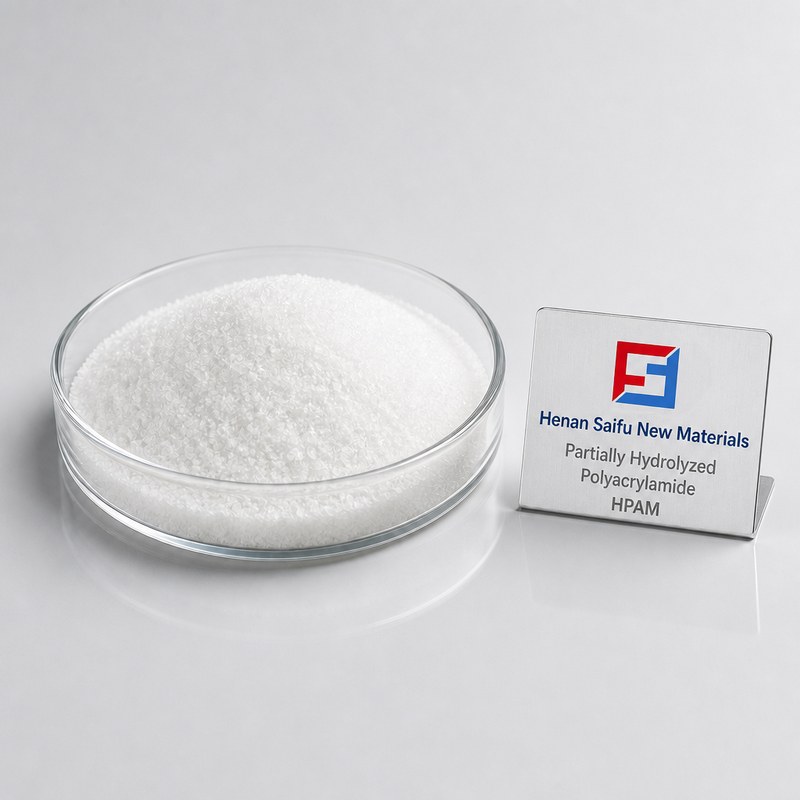
High molecular weight partially hydrolyzed polyacrylamide engineered for polymer flooding, mobility control and drilling fluid applications.
Partially hydrolyzed polyacrylamide occupies the high-viscosity end of the polyacrylamide family. A controlled fraction of the amide groups is converted to carboxylate, which makes the chain extend and entangle in water; the result is a solution whose viscosity is far higher than the same concentration of unhydrolyzed polymer could reach. That viscosity is the whole point in enhanced oil recovery, where the polymer is used to thicken injected water so it displaces oil more efficiently instead of channelling through the more permeable parts of the reservoir.
Specification is a balancing act. Molecular weight sets the viscosity yield, but very high molecular weight brings mechanical and thermal degradation risk in the injection system and near the wellbore. Hydrolysis degree sets both the viscosity and the sensitivity to reservoir brine: divalent ions such as calcium and magnesium cross-link the carboxylate groups and can precipitate the polymer if the hydrolysis degree is too high for the salinity. High-salinity, high-temperature reservoirs therefore call for lower hydrolysis; fresher, cooler reservoirs tolerate higher hydrolysis and gain more viscosity from it.
| CAS No. | 9003-05-8 |
|---|---|
| Chemical family | Acrylamide / sodium acrylate copolymer |
| Ionic charge | Anionic (partially hydrolyzed) |
| Degree of hydrolysis | 5% – 35%, adjusted to reservoir conditions |
| Molecular weight | 8 – 20 million |
| Appearance | White to off-white granules |
| Solid content | ≥ 88% |
| Bulk density | 0.60 – 0.80 g/cm³ |
| Particle size | < 2 mm, ≥ 90% passing |
| Dissolution time | 60 – 120 minutes at 0.1% solution |
| Water insolubles | ≤ 0.2% |
| Viscosity (1000 mg/L, 25 °C, deionised) | Supplied per batch, typically 40 – 80 mPa·s |
| Packaging | 25 kg woven bags / 750 kg and 1000 kg bulk bags |
| Shelf life | 24 months in unopened packaging, cool and dry |
HPAM is dissolved in the injection or make-up water to a stock concentration of 5000 mg/L or less, then diluted in line to the target injection strength. Because the polymer is sensitive to shear and to dissolved ions, the make-up system matters as much as the product: use a low-shear dispersing unit, generous maturation tankage so the solution is fully developed before it reaches the well, and oxygen-scavenged water where the reservoir is hot. Concentrations in polymer flooding are typically 500 – 2000 mg/L, settled by reservoir simulation and a pilot before field-wide injection. Avoid centrifugal pumps and long choke drops, which break the chain permanently and destroy the viscosity you have paid for.
Typical dosage. Typically 500 – 2000 mg/L in injection water for polymer flooding. Dose is set by reservoir simulation and confirmed in a pilot.
What hydrolysis degree do I need? It is set by the reservoir, not by preference. High-salinity water and high temperature require a lower hydrolysis degree, because divalent ions cross-link the carboxylate groups and can precipitate the polymer. Lower-salinity, cooler reservoirs allow a higher degree and give more viscosity for the same mass. Send us the brine analysis and reservoir temperature and we will narrow the range.
What concentration is used in polymer flooding? Most projects run between 500 and 2000 mg/L in the injection water, chosen from reservoir simulation and confirmed in a single-well or pattern pilot. The optimum is a balance between incremental recovery and the cost of polymer per barrel of oil.
Why is shear such a concern? The viscosity comes from the length of the polymer chain. Mechanical shear cuts the chain irreversibly, so the solution never recovers its viscosity. Centrifugal pumps, chokes, valves and sharp fittings are the usual culprits and should be avoided or replaced with low-shear alternatives.
How does it compare with APAM for oilfield use? HPAM is the tailored, higher-viscosity version: the hydrolysis degree is selected for the reservoir and the grade is controlled for solution viscosity rather than for clarification performance. APAM is a general flocculant for water and tailings treatment.
Can you help design the make-up system? Yes. We can advise on dispersion, maturation tankage, dilution and filtration so the polymer reaching the well is fully developed and free of gel — the two things that most often undermine a flooding programme.
Do you supply pilot quantities? Yes, we can supply drums and bags for a pilot, with the batch analysis needed to feed the simulation model.