Economical brown granule polyaluminium chloride for high-volume industrial effluent where treatment cost per cubic metre is the deciding factor.
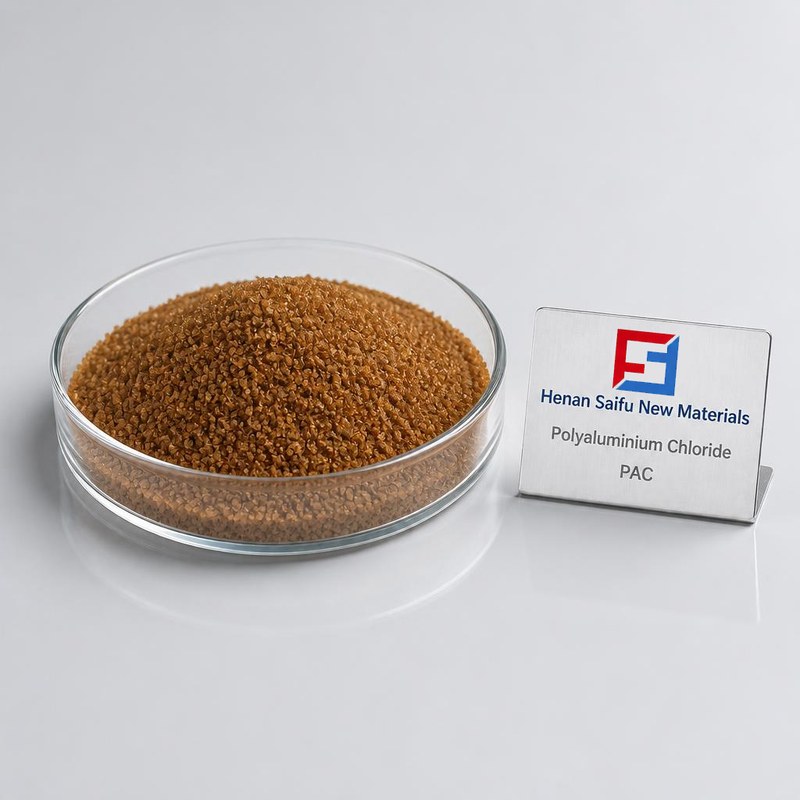
Brown granule PAC delivers the same coagulation chemistry as the yellow grades at the lowest cost per tonne. The colour comes from iron and residual raw-material impurities rather than from any difference in the aluminium polymer itself, so Al2O3 content and basicity remain the parameters that decide how it performs. Where the treated water is discharged to a works inlet or reused in a process that does not care about a slight tint, this is the grade that keeps treatment cost per cubic metre down.
It is also the most convenient grade to handle in bulk. Granule flows without dust, feeds accurately through screw or gravity systems, and dissolves quickly in a make-up tank with mechanical stirring. For plants treating large volumes of turbid water — aggregate washing, construction runoff, pre-treatment ahead of biological stages — a lower-grade coagulant used in a well-controlled programme usually beats a premium grade used carelessly.
| Chemical name | Polyaluminium chloride (basic aluminium chloride) |
|---|---|
| Grade | Industrial, to GB/T 22627 |
| Appearance | Brown granule |
| Al2O3 content | ≥ 26% |
| Basicity | 40% – 85% |
| pH (1% solution) | 3.5 – 5.0 |
| Water insolubles | ≤ 1.5% |
| Particle size | 0.5 – 6 mm |
| Bulk density | 0.65 – 0.90 g/cm³ |
| Shelf life | 24 months in unopened packaging, cool and dry |
| Packaging | 25 kg woven bags / 1000 kg bulk bags |
Dissolve the granule to a 5% – 10% solution with mechanical stirring; the granule wets out faster than powder and does not form floating lumps at the water surface. Dose into rapid mixing so the coagulant makes contact within seconds, then flocculate gently. Because the Al2O3 content is lower than the yellow grades, the working dose is correspondingly higher for the same duty — but the cost per cubic metre treated is normally still lower. The usual control point is settled or filtered turbidity, checked hourly during commissioning and then at the frequency the plant's variability demands.
Typical dosage. Typical 15 – 200 g per m³. Dose is roughly 10% higher than for a 28% yellow grade for the same duty.
Is brown PAC a lower quality product? It is a lower grade, not a defective one. The colour comes from iron and raw-material traces and has no bearing on the coagulation mechanism. Compare Al2O3 content and basicity, not colour, when choosing between it and the yellow grade.
When is the brown grade the right choice? Whenever the treated water does not need to be colourless. If the effluent discharges to a municipal works inlet, or the water is recycled into a process that tolerates a tint, the saving per tonne is real and the performance is adequate.
What is the difference in dose compared with yellow PAC? Expect roughly 10% more product by weight for the same turbidity removal, because the Al2O3 content is lower. The cost per cubic metre treated is normally still lower, which is why the grade is used.
Does it age in storage? Granule keeps for about 24 months in unopened bags in a dry store. Once opened, reseal the bag after use; moisture pickup causes caking and makes the screw feeder unreliable.
Can it be used for drinking water? No. Drinking water requires the potable-water grades produced to the tighter heavy-metal and insolubles limits of the drinking water standard. Use the dedicated yellow or white drinking water grades for that duty.
Do you supply in bulk for large plants? Yes. The brown grade is most often supplied in 1000 kg bulk bags, which suits plants with silo, screw or pneumatic feeding and keeps packaging cost down.