Iron-based inorganic polymer coagulant for colour, turbidity and phosphorus removal, effective at low temperature and over a wide pH range.
Polyferric sulfate is an inorganic polymer coagulant built on ferric iron rather than aluminium. The pre-polymerised iron hydrolyses rapidly to form dense, heavy flocs that settle faster than aluminium flocs and bind phosphate and colour bodies strongly. That combination makes PFS the first choice where phosphorus removal or decolourisation is the primary duty, rather than simple turbidity removal.
Its practical advantages show up most clearly in difficult conditions. Iron-based coagulants keep working at low water temperature, where aluminium salts become sluggish and need much higher doses. They also perform across a wider pH band, and the dense floc tolerates higher hydraulic loading in the clarifier. The trade-offs are equally real: PFS is acidic and corrosive in concentrated form so it needs plastic or lined equipment, it adds iron to the treated water and can tint it slightly, and it produces more sludge than PAC for the same turbidity removal. On coloured or phosphorus-bearing water, the improvement in effluent quality usually outweighs those points.
| Chemical name | Polyferric sulfate |
|---|---|
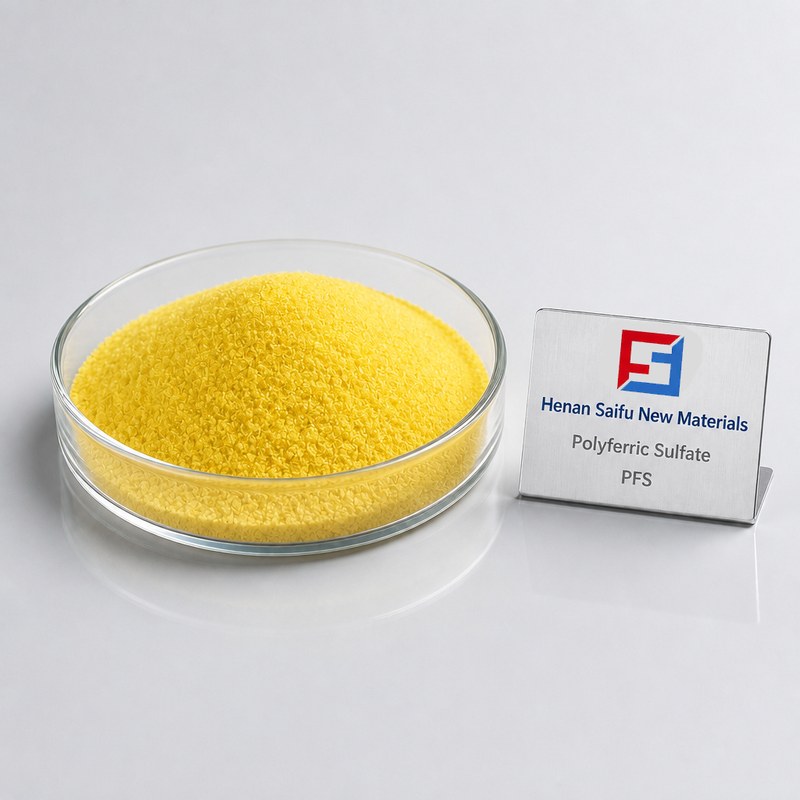
| Appearance | Yellow to light brown powder |
| Total iron content | ≥ 19% |
| Ferric iron (Fe3+) | ≥ 18% |
| Basicity | 8% – 16% |
| pH (1% solution) | 2.0 – 3.0 |
| Water insolubles | ≤ 0.5% |
| Arsenic (as As) | ≤ 0.0005% |
| Heavy metals (as Pb) | ≤ 0.002% |
| Shelf life | 12 – 24 months in unopened packaging, dry and cool |
| Packaging | 25 kg woven bags / 1000 kg bulk bags |
Prepare a 10% – 20% working solution from the dry powder and dose it into rapid mixing, exactly as for PAC. PFS is strongly acidic in concentrate, so use plastic, GRP or lined steel for tanks, pipework and dosing pumps, and add the powder to water rather than water to the powder. For phosphorus removal the dose is set by the molar ratio of iron to influent phosphate rather than by turbidity, and the practical figure is established by dosing to a target residual phosphate in a jar test. Hold the reaction pH between 5.5 and 7.5; too low and the iron stays soluble and passes through, too high and the floc becomes bulky and slow.
Typical dosage. Typical 20 – 200 g per m³. For phosphorus removal, dose to a target residual phosphate by jar test.
PFS or PAC for our plant? Choose PFS when colour or phosphorus is the problem, or when the water is cold. Choose PAC when the duty is straightforward turbidity removal and cost efficiency matters most. If your consent includes a phosphate limit, PFS is normally the more reliable route.
How is the dose calculated for phosphorus removal? By the ratio of iron to influent phosphate rather than by turbidity. A jar test dosed to a target residual phosphate gives the working ratio, and the plant then doses to a flow-proportional setpoint with occasional verification.
Does PFS add colour to the treated water? It can leave a slight iron tint, and the ferric ion itself is coloured. On duties where the final water must be colourless, check the residual iron in a jar test, or consider a high-purity PAC grade instead.
Why does the equipment have to be corrosion resistant? The 1% solution sits around pH 2 to 3 and the concentrate is more aggressive still. Plastic, GRP or lined steel is standard practice; unprotected mild steel will corrode quickly, especially at the dosing point where the solution is most concentrated.
How much sludge does it produce? More than PAC for the same turbidity removal, because the iron hydroxide floc is denser and the iron dose is higher. The trade-off is worth it where phosphorus or colour removal is mandatory, and the denser floc normally dewaters well.
What is the shelf life of the powder? Around 12 to 24 months in unopened packaging in a dry store. Once opened, reseal the bag after use — absorbed moisture causes caking and, in this product, accelerates corrosion of the container.