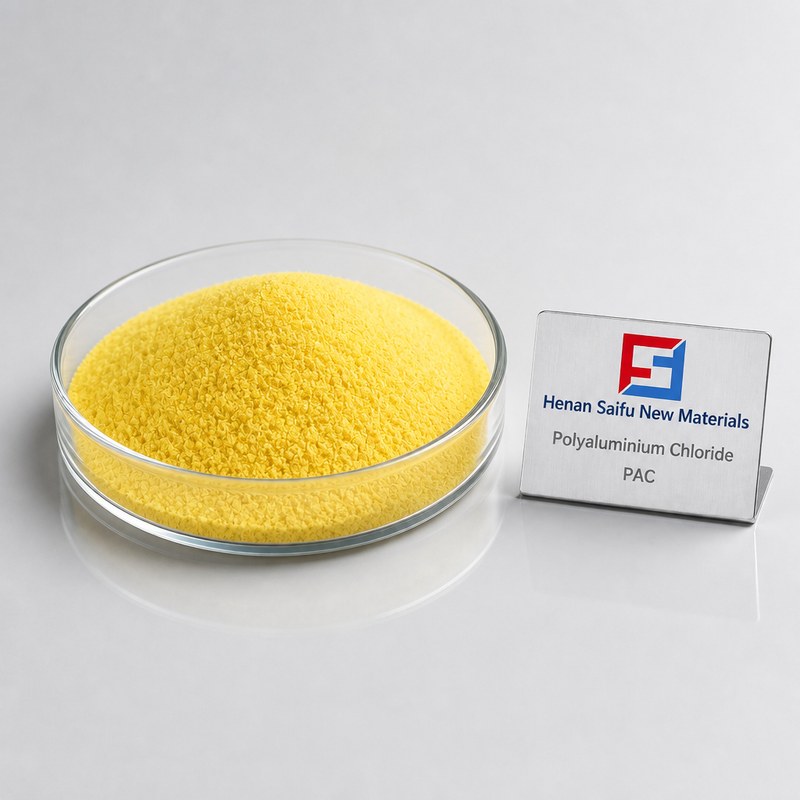
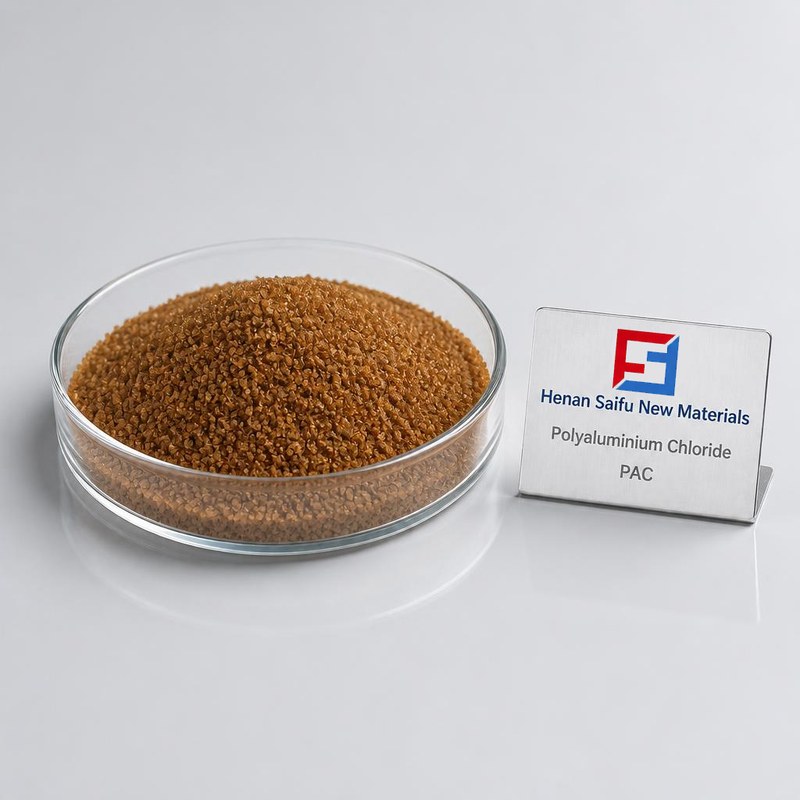
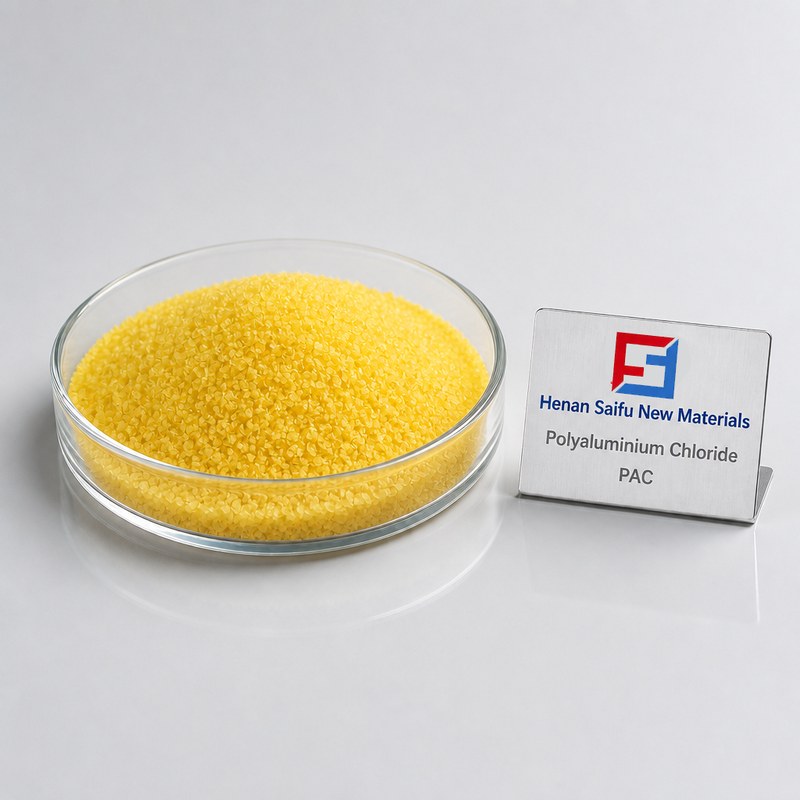
Yellow granule polyaluminium chloride combining full industrial Al2O3 content with dust-free handling and fast dissolution.
Yellow granule PAC is the middle position in the range: the full industrial Al2O3 content of the yellow powder, in a form that can be poured, fed and dissolved without raising a cloud of dust. In a plant where operators work close to the dosing station, dust is not just a housekeeping problem — it irritates eyes and airways, coats equipment, and leads to losses that show up as unexplained dosing variation.
Mechanically, granule also feeds more accurately. A screw or gravity feeder handles it consistently, whereas powder tends to bridge, flush and compact in the hopper, which changes the actual dose even when the setpoint has not moved. The trade-off is a slightly longer dissolution time and a slightly higher cost per tonne. For most plants treating industrial effluent the difference is paid back quickly in steadier effluent quality and a cleaner working environment.
| Chemical name | Polyaluminium chloride (basic aluminium chloride) |
|---|---|
| Grade | Industrial, to GB/T 22627 |
| Appearance | Yellow granule |
| Al2O3 content | ≥ 28% |
| Basicity | 40% – 90% |
| pH (1% solution) | 3.5 – 5.0 |
| Water insolubles | ≤ 0.5% |
| Particle size | 0.5 – 6 mm |
| Bulk density | 0.65 – 0.90 g/cm³ |
| Shelf life | 24 months in unopened packaging, cool and dry |
| Packaging | 25 kg woven bags / 1000 kg bulk bags |
Prepare a 5% – 10% solution in a stirred tank; the granule wets out faster than powder and does not clump on the surface. Because the granule flows freely, the make-up concentration stays close to what the operator intended, which is the main practical advantage over powder. Dose into rapid mixing, allow gentle flocculation, and hold the reaction pH between 6 and 8. If the plant has a jar-test kit, use it to re-check the dose whenever the influent quality shifts — the correct dose for a colour-loaded effluent can be two or three times the dose for a simple turbidity load.
Typical dosage. Typical 10 – 150 g per m³. Prepare a 5% – 10% solution and control reaction pH between 6 and 8.
Powder or granule — which should we buy? If your plant prepares coagulant by hand or feeds it through a screw, granule is usually the better buy: less dust, less spillage and a more consistent make-up strength. If you have an enclosed dissolving system and want the lowest cost per unit of Al2O3, powder is cheaper.
Does granule dissolve as quickly as powder? It takes slightly longer, but in practice the difference disappears inside a normal make-up cycle. The granule does not float and clump the way powder can, so the solution is often more uniform by the time it is dosed.
Why does feed accuracy matter so much? Because an overdosed coagulant wastes money and can re-stabilise the colloids, while an underdosed one leaves turbidity in the effluent. Powder that bridges in the hopper changes the real dose without moving the setpoint, which makes the plant hard to control.
Can we use it in the same dosing equipment as powder? Yes. Granule works in the same tanks and pumps. Screw and gravity feeders generally handle granule better, and you may need to shorten the mixing time slightly to match the previous powder cycle.
How should it be stored? Sealed, dry and off the floor, away from alkalis. The product is hygroscopic; an opened bag should be resealed after use or the granule will cake and feed poorly.
What documentation comes with the shipment? A batch certificate of analysis covering Al2O3, basicity, pH and water insolubles, plus the safety data sheet on request.